JBL L50
1978 - 1982
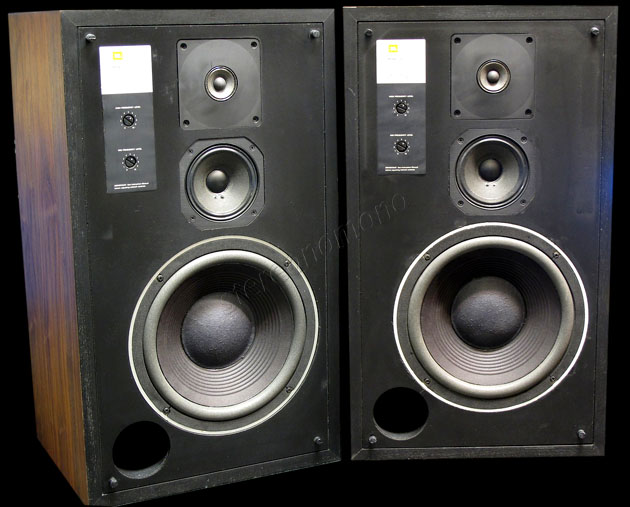
The L50 was a stylish 3-way bookshelf speaker featuring JBL's distinctive wavy diagonal grille design. It combined advanced driver technology including a sealed midrange chamber and holographically-optimized cone with a unique aesthetic that set it apart visually.
Specifications
| Type | 3-way, 3-speaker, Bass Reflex, Bookshelf |
|---|---|
| Drivers | Woofer: 10" 127A, Midrange: 5" LE5-10, Tweeter: LE26 |
| Crossover Frequencies | 800 Hz, 3 kHz |
| Nominal Impedance | 8 Ω |
| Power Handling | 35W (continuous program) |
| Sensitivity | 88 dB/W/m |
| Frequency Response | 45 Hz - 20 kHz |
| Dimensions | 362 x 622 x 314 mm (W x H x D) |
| Weight | 21 kg (per speaker) |
Drivers Used
- Woofer: 127A - 10" (25cm) cone woofer with ribbed corn, 5cm copper ribbon voice coil, and glass wool shell
- Midrange: LE5-10 - 5" (13cm) cone midrange with 2.2cm voice coil, aluminum center dome, housed in sealed sub-chamber
- Tweeter: LE26 - 3.6cm cone tweeter with 1.6cm voice coil and 15,000 Gauss magnetic circuit
Design Features
The L50 incorporated several advanced technologies:
- Sealed Midrange: The LE5-10 was housed in a completely sealed back cavity filled with sound absorbing material, reducing woofer interference and distortion
- Holographic Analysis: The LE5-10 cone material was optimized using fast-reacting laser beam holographic analysis during development
- Aluminum Center Dome: Extended midrange response and improved transition to tweeter
- LE26 Tweeter: Hard material gradient around cone periphery removed harmful reflections and phase distortion
- Inline Mounting: Drivers mounted in a straight line for smooth sound range connection
- Variable Controls: Continuously variable level controls for mid and high frequencies
Unique Grille Design
The L50's most visually distinctive feature was its wavy diagonal grille pattern, available in three colors: blue, red, and brown. This design was unique to the L50 and became a signature element.
Advanced Network Design
The crossover used new technology to flatten impedance and correct phase:
- Low-loss air-core inductors
- High-voltage capacitors
- Precision resistors to reduce distortion
- One-touch terminals for secure connections
Variants
- L50 (1978-1982): Original version with walnut finish and wavy grille
- L50A: Updated variant
- Grille Colors: Blue, red, and brown options
Historical Context
The L50 demonstrated that JBL could combine serious engineering with distinctive styling. The holographic analysis used to optimize the LE5-10 midrange was cutting-edge technology, while the sealed sub-chamber design showed attention to reducing intermodulation distortion. These features made the L50 a technically sophisticated speaker in its class.
The wavy grille design was a departure from JBL's traditional geometric patterns, showing the company was willing to experiment aesthetically while maintaining acoustic excellence.
Related Models
The L50 shared its 127A woofer with the L40 but added the dedicated LE5-10 midrange and LE26 tweeter. It was positioned as a stylish alternative to the more conventional L36 Decade.
Documentation
No specific datasheet available in archive. See JBL Loudspeaker Components 1979 Catalog for related information.