JBL L250
1982 - 1985
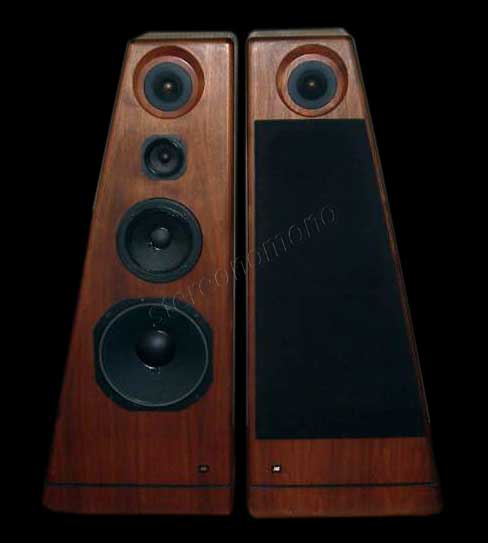
The L250 was JBL's flagship consumer speaker of the early 1980s, representing the culmination of the company's acoustic engineering expertise. With its unique slanted baffle, four-way design, and exquisite wood finishes, it set new standards for home high-fidelity reproduction.
Specifications
| Type | 4-way, 4-speaker, Bass Reflex, Floor Standing |
|---|---|
| Drivers | Woofer: 14" LE14H-1, Mid-Woofer: 8" 108H, Midrange: 5" LE5-11, Tweeter: 044-1 Dome |
| Crossover Frequencies | 400 Hz, 1.6 kHz, 4.5 kHz |
| Nominal Impedance | 8 Ω |
| Power Handling | 200W (IEC) |
| Sensitivity | 90 dB/W/m |
| Frequency Response | 25 Hz - 20 kHz |
| Dimensions | 572 x 1,321 x 362 mm (W x H x D) |
| Weight | 61.4 kg (per speaker) |
Drivers Used
- Woofer: LE14H-1 - 14" (36cm) cone woofer with SFG magnetic circuit and Aqua Plus treated cone
- Mid-Woofer: 108H - 8" (20cm) cone driver with SFG magnetic circuit
- Midrange: LE5-11 - 5" (12.5cm) cone midrange with copper coil for minimized power compression
- Tweeter: 044-1 - 2.5cm dome tweeter with phenol diaphragm
Design Excellence
The L250 was engineered without compromise:
- Round-and-Slant Baffle: Trapezoidal front panel with curved edges prevented sound diffraction and minimized peaks and dips
- Symmetrical Driver Layout: Improved sound image localization
- SFG Magnetic Circuits: Symmetrical Field Geometry design in woofers for low distortion
- Aqua Plus Treatment: Cone treated on both sides for increased rigidity and moderate damping
- 6dB/Octave Crossover: All crossover points unified for smooth power response
- Bus Bar Attenuation: Replaced conventional variable attenuators to prevent sound quality deterioration
Premium Finishes
The L250 was available in a range of exquisite finishes:
- Walnut (standard)
- Black
- Oak
- Ebony (special order)
- Rosewood (special order)
Technical Innovations
The L250 introduced several technical refinements:
- Power Compression Minimization: Copper coils used throughout to minimize power compression at high levels
- Wide Dynamic Range: High efficiency design maintained across all drivers
- Phase Coherence: Slanted baffle aligned driver phases for optimal listening position
- Diffraction Control: Curved baffle edges eliminated cabinet edge diffraction effects
Variants
- L250 (1982-1985): Original flagship model
- L250 Plus: Updated version with minor refinements
- Finish Options: Walnut, Black, Oak (standard); Ebony, Rosewood (special order)
Historical Context
Introduced in 1982, the L250 represented the pinnacle of JBL's consumer speaker development before the company shifted focus to different market segments. It combined lessons learned from the L300 Summit with new technologies like the SFG magnetic circuits and Aqua Plus cone treatment developed for the professional market.
The four-way design allowed each driver to operate in its optimal frequency range, with the 108H mid-woofer bridging the gap between the massive LE14H-1 and the midrange LE5-11. This complexity was justified by the resulting transparency and effortlessness that smaller speakers couldn't match.
Related Models
The L250 succeeded the L300 Summit as JBL's flagship consumer speaker. It was later succeeded by the L250 Plus and eventually the Ti-series. The L250's LE14H-1 woofer and 044 tweeter connected it to JBL's professional heritage.
Documentation
No specific datasheet available in archive. See JBL Loudspeaker Components 1979 Catalog for related information.