JBL 4355 Studio Monitor
1981 - 1986
The JBL 4355 is the ultimate expression of JBL's studio monitor philosophy - a four-way, five-driver floor-standing system designed for the most demanding professional applications. Based on the legendary 4345 but enhanced with JBL's most advanced components, the 4355 represents the pinnacle of analog loudspeaker engineering.
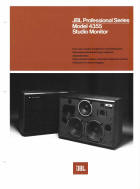
Specifications
| Type | 4-way, 5-speaker, Bass Reflex, Floor-standing Studio Monitor |
|---|---|
| Drivers | Woofer: 2x 15" 2235H, Mid-bass: 10" 2202H, Midrange: 2441 compression driver with 2308/2307 horn, Tweeter: 2405H slot tweeter |
| Crossover Frequencies | 290 Hz, 1.2 kHz, 10 kHz |
| Nominal Impedance | 4 Ω (bi-amp capable) |
| Power Handling | Bass: 400W, Mid/High: 200W |
| Frequency Response | 31.5 Hz - 18 kHz (±3dB) |
| Sensitivity | 94 dB/W/m |
| Dimensions | 1092 x 1460 x 483 mm (W x H x D) |
| Weight | 156 kg per speaker |
Drivers Used
- Low Frequency: Two 2235H 15" woofers with SFG magnets
- Mid-Bass: 2202H 10" midrange driver in sealed chamber
- Midrange: 2441 compression driver with 2308/2307 bi-radial horn
- High Frequency: 2405H "bullet" slot tweeter
Key Features
- Bi-amplification capability with active crossover at 290 Hz
- Adjustable tweeter level via front panel attenuator
- Massive bass response from dual 15" woofers in tuned enclosure
- Constant directivity horn (140° x 40° coverage)
- Professional grade construction for studio environments
Historical Context
The 4355 was introduced in 1981 as JBL's flagship studio monitor, succeeding the renowned 4345. Designed by Greg Timbers and the JBL engineering team, it represented the culmination of decades of research into high-level, low-distortion loudspeaker systems.
Unlike consumer speakers, the 4355 was designed for professional monitoring applications where accuracy and dynamic range are critical. The dual 15" woofers, massive cabinet volume, and professional-grade components made it one of the most capable studio monitors of its era.
Production was limited due to the cost and complexity of manufacturing, making the 4355 one of the rarest and most collectible JBL studio monitors today.
Related Models
- L300 Summit - Consumer version sharing similar DNA
- L200 Studio Master - Smaller studio monitor
- 4345 - Predecessor with similar configuration
Documentation
- JBL 4355 Studio Monitor Datasheet (PDF)
- JBL 4355 Schematics (PDF)
- JBL 4310 Control Monitor Archive (PDF) - Related studio monitor documentation
External Resources
- Lansing Heritage - 4355 Specifications
- AudioKarma JBL Forum - Community discussions and restoration info